
Biocomputation
The brain as a device for computation, broadly conceived.
Biocomputation begins with the modern paradigm and interrogates it. The contemporary brain sciences assume the brain is, in some sense, a computer; the careful reply is to ask, in detail, what must be true if it is and what must be true if it is not. Our work brings together researchers across quantitative neuroscience, biophysics, neuromorphic engineering and the related formal sciences. The objects of study are the operating principles, abilities and limitations that, if the analogy holds, must differ radically from those of any artificial computer we have built; and that, if it does not, the analogy itself should make legible.
- If the brain is a computer, what kind of computer is it and crucially why?
- What computations do dendrites, single neurons and small circuits perform and which admit a useful artificial analogue?
- How do biological substrates (fungal, microbial, neuronal) compute, broadly conceived?
- Where does the analogy with artificial computation cease to be productive?
Conferences
Biocomputation has been a session of the Annual Conference and a recurring thread across the AE Global Summit. The questions are old; the methods are new.
Spotlight- Enriched experiences increase symmetrical connectivity and sparsity in association cortex
Spotlight talk by Dr Rajat Saxena presents "Enriched experiences increase symmetrical connectivity and sparsity in association cortex" Abstr…
Watch →
From McCulloch-Pitts to Retina (Dr Chris Hillar)
Dr Chris Hillar from New Theory AI presents his talk "From McCulloch-Pitts to Retina" Theoretical constructs from biophysics have profoundly…
Watch →
Motor planning under uncertainty (Dr Juan Gallego)
Dr Juan Gallego from imperial University presents his talk on "Motor planning under uncertainty" Animals use feedback to rapidly correct ong…
Watch →
Cell types and layers shape the geometry of neural representations: a biophysical model of neocortex
Spotlight talk from Steeve Laquitaine (EPFL) at the 5th International Convention on the Mathematics of Neuroscience and Artificial Intellige…
Watch →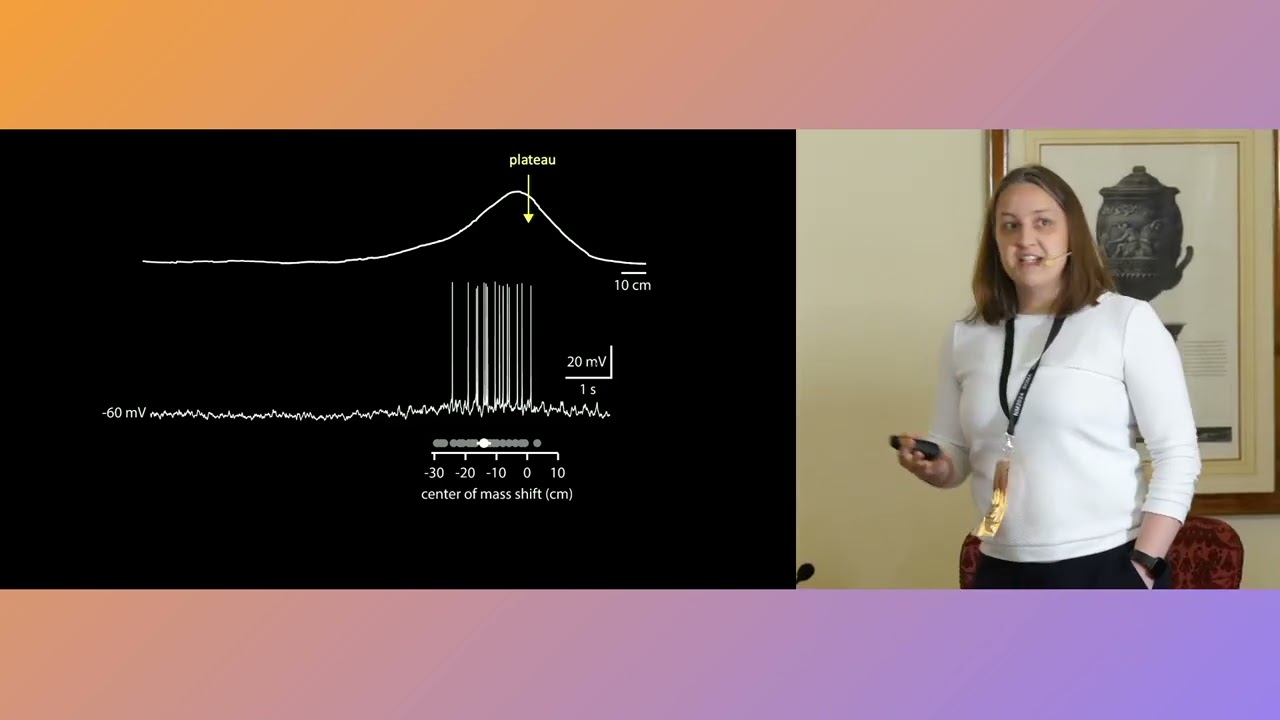
Dendritic computations underlying experience-dependent hippocampal representation - Prof Grienberger
Invited talk from Professor Christine Grienberger (Brandeis) at the 5th International Convention on the Mathematics of Neuroscience and Arti…
Watch →
Dr Ilias Rentzeperis - Modelling a continuum of simple to complex cell behaviour in V1 with INRF
A recent model of neural summation, the intrinsically nonlinear receptive field (INRF), has shown very promising results in overcoming the l…
Watch →ThAT Ambassador Programme
The Thinking About Thinking Ambassador Programme is an open, application-based pathway for students and early-career researchers who wish to take part in serious, interdisciplinary conversations about intelligence. Ambassadors support our conferences, workshops, and community initiatives; in turn, they help to extend thoughtful dialogue across universities, disciplines and countries. The programme is designed for those who care, in earnest, about ideas, collaboration, and the construction of intellectual community.
Outstanding ambassadors who, over time, demonstrate sustained contribution, leadership and intellectual engagement may, in due course, be invited into the Thinking About Thinking Fellowship, a private, invitation-only programme reserved for long-term contributors to the work.