Neuroscience
The computational principles of perception, memory and behaviour, studied in real brains.
We start from one assumption: right now, intelligence is best studied in the natural systems that have it. We're interested in how the brain represents information and how that turns into behaviour. We look at the computational principles behind perception, memory and learning, and at the biological, physical and theoretical constraints any account of the mind has to respect. These questions sit between systems and computational neuroscience, cognitive science and the formal sciences. Our job is to bring together the people who each hold part of the answer, and keep them talking.
- How is information represented in the brain, and how do those representations produce behaviour?
- What computational principles underlie perception, memory and learning?
- What role do neural circuits play in cognition, and in consciousness?
- Which biological constraints and which abstractions should inform a theory of intelligence?
- Where do findings in AI help us understand the brain, and where don't they?
Conferences
Neuroscience is the other main thread in our work. The Conference on the Mathematics of Neuroscience and AI covers the biological, mathematical and computational foundations of intelligence, with peer-reviewed talks on open problems. At the AE Global Summit, the same questions come up against applications, institutions and governance.
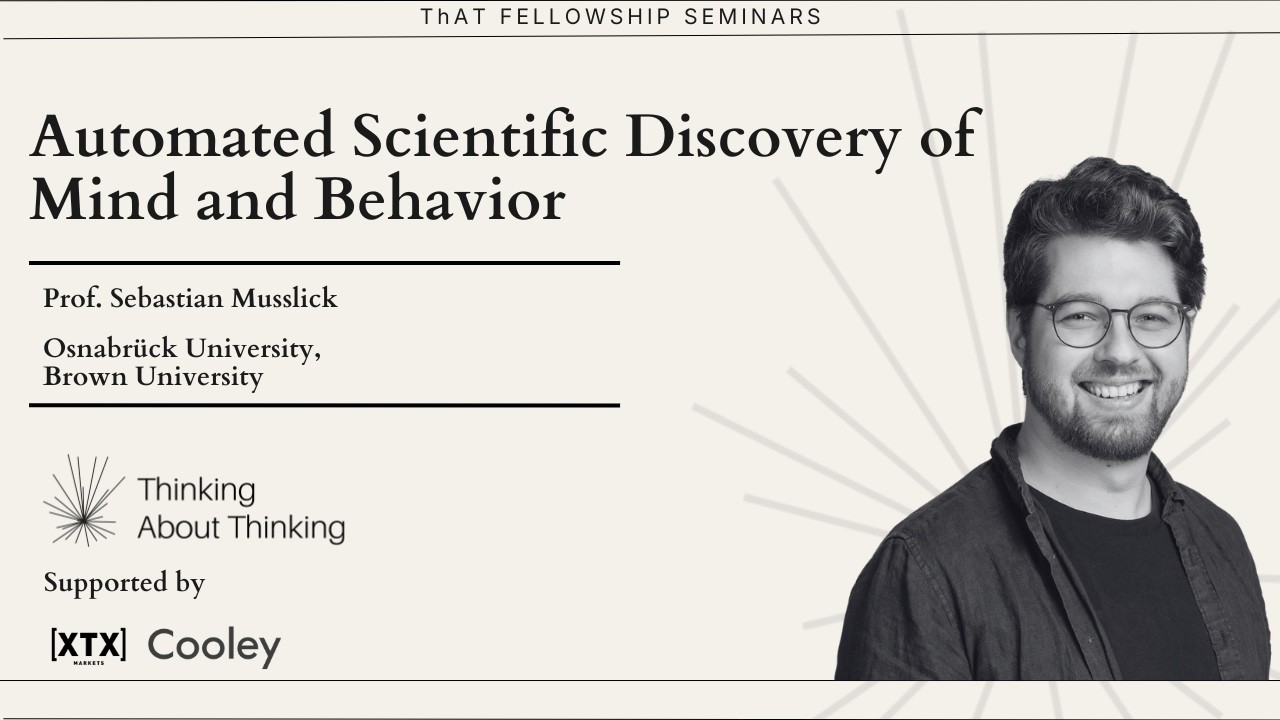
Fellowship Seminars:Automated Scientific Discovery of Mind and Behavior with Prof. Sebastian Mußlick
For our first session, Prof. Sebastian Mußlick will present a framework for automated scientific discovery in cognitive science, exploring h…
Watch →
Panel Discussion - "Open Problems in Computational Neuroscience"
Panel discussion on the topic of “Open Problems in Computational Neuroscience” Panel guests: Dr James Whittington (Chair) Professor Wolfgang…
Watch →
Mood as a vehicle of reinforcement learning (Professor Eran Eldar)
Professor Eran Eldar presents "Mood as a vehicle of reinforcement learning" Abstract - The science of learning and decision-making has large…
Watch →
Spotlight- Dynamical systems principles underlie the ubiquity of biological data manifolds
Spotlight talk by Dr Arthur Pellegrino presents "Dynamical systems principles underlie the ubiquity of biological data manifolds" Abstract -…
Watch →
Spotlight- Estimating flexible across-area communication with neurally-constrained RNNs
Spotlight talk by Philipp Werthmann presents "Estimating flexible across-area communication with neurally-constrained RNNs" Abstract - Previ…
Watch →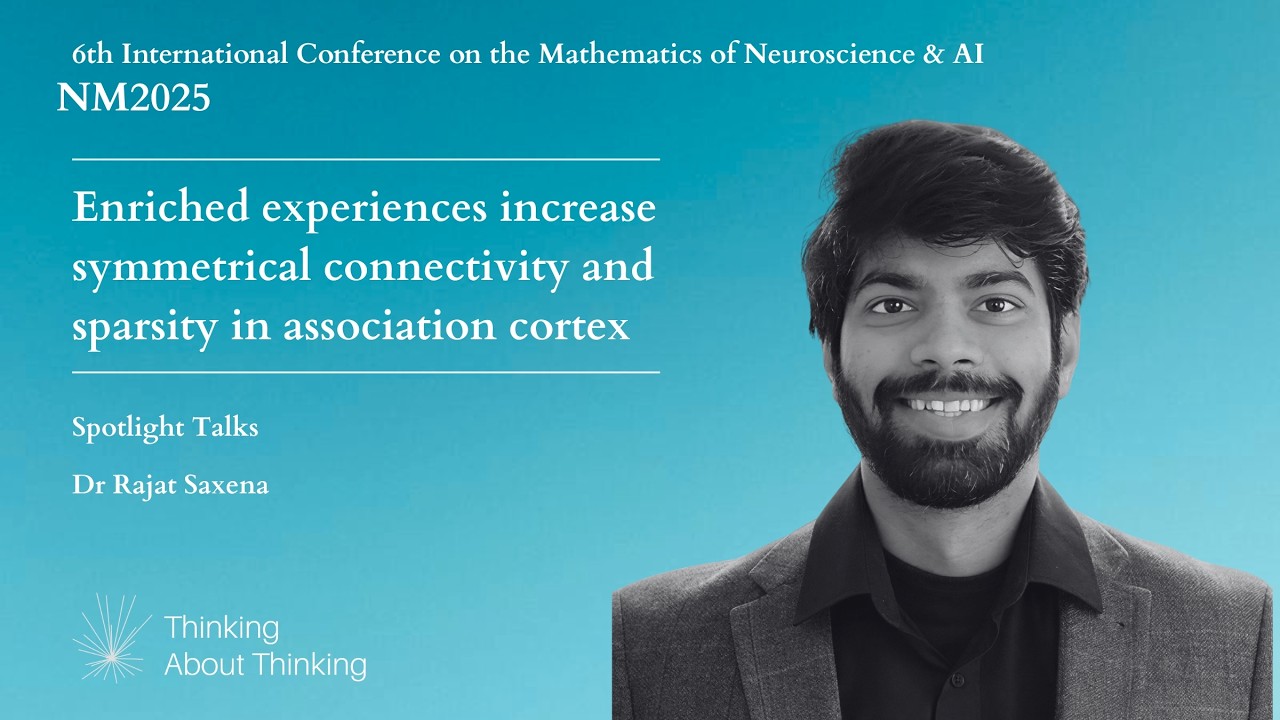
Spotlight- Enriched experiences increase symmetrical connectivity and sparsity in association cortex
Spotlight talk by Dr Rajat Saxena presents "Enriched experiences increase symmetrical connectivity and sparsity in association cortex" Abstr…
Watch →ThAT Ambassador Programme
The Thinking About Thinking Ambassador Programme is open to applications from students and early-career researchers who want to work on intelligence across fields. Ambassadors help run our conferences, workshops and community projects, and bring their universities and countries into the network.
Ambassadors who contribute and lead over a longer period may be invited into the Thinking About Thinking Fellowship. The Fellowship is invitation-only and is for long-term contributors.